Modern Physics · 27 April 2026↻ Updated 17 Aug 2026
The Photoelectric Effect Explained: How Photons Eject Electrons
In 1887, Heinrich Hertz noticed something strange: shining ultraviolet light on a metal surface made it emit sparks more easily. Nobody could explain why. Eighteen years later, a twenty-six-year-old patent clerk named Albert Einstein published a two-page paper that solved the mystery — and permanently shattered the classical picture of light.
It earned him the Nobel Prize in Physics in 1921. Not relativity. This.
Instantaneous emission. KE depends on frequency.
Photon Energy
3.10 eV
Work Function φ
2.28 eV
Max KE
0.82 eV
Current
1.7 μA
Threshold: 544 nm
1. The Puzzle Classical Physics Couldn't Solve
Classical wave theory predicted that light energy is spread continuously over a wavefront. Shine brighter light on a metal, and electrons should gain more energy. Shine longer and electrons should eventually accumulate enough to escape, regardless of frequency.
Every one of these predictions turned out to be wrong.
What experiment actually showed:
- Frequency below a threshold → no electrons, ever. No matter how bright the light or how long you wait.
- Frequency above the threshold → electrons appear instantly, even under the faintest illumination.
- Brighter light → more electrons, but no faster ones.
- Higher frequency → faster electrons, regardless of brightness.
Wave theory had no answer. The energy was arriving continuously — so why did frequency matter at all?
2. Einstein's 1905 Insight: Light Comes in Packets
Einstein borrowed an idea from Max Planck: energy is not continuous. He proposed that light consists of discrete packets — quanta, now called photons — each carrying energy proportional to its frequency:
where:
- J·s eV·s (Planck's constant)
- = frequency of light (Hz)
- = wavelength (m)
- m/s (speed of light)
A single photon either has enough energy to knock out an electron, or it doesn't. Brightness only controls how many photons arrive per second — not the energy of each one. This is why intensity adds more electrons but doesn't make them faster.
Try it: Keep the metal as Sodium and drag the wavelength slider from 700 nm (red) down toward 400 nm (violet). Watch for the moment emission starts — that's the threshold wavelength for Sodium at 544 nm.
3. Work Function — the Metal's Energy Toll
Every electron inside a metal is bound to the surface. To escape, it must pay an energy toll called the work function (), measured in electron-volts (eV):
| Metal | Work Function φ | Threshold Wavelength |
|---|---|---|
| Sodium (Na) | 2.28 eV | 544 nm (green) |
| Potassium (K) | 2.30 eV | 539 nm (green) |
| Zinc (Zn) | 4.30 eV | 289 nm (UV) |
| Copper (Cu) | 4.70 eV | 264 nm (UV) |
| Silver (Ag) | 4.73 eV | 262 nm (UV) |
Sodium and potassium are so reactive that even visible green or yellow light can eject electrons. Zinc, copper, and silver need ultraviolet — a photon with much higher energy per quantum.
The threshold frequency is the minimum frequency at which a photon can just barely eject an electron (with zero kinetic energy left over):
Try it: Switch between Sodium and Copper in the metal dropdown. Visible blue light (420 nm, 2.95 eV) ejects electrons from Sodium but has no effect on Copper — its work function of 4.70 eV demands UV photons.
4. The Key Equation: KE_max = hf − φ
When a photon does have enough energy, the excess above the work function becomes kinetic energy of the ejected electron:
The stat cards in the simulation show this directly: Photon Energy (), Work Function (), and Max KE () update live as you adjust the wavelength and metal.
Note: this is the maximum kinetic energy. Electrons deeper in the metal lose some energy on their way out. Only surface electrons get the full amount.
5. What Intensity Actually Controls
Intensity (brightness) = number of photons per second. Each photon independently ejects at most one electron. So:
- More photons → more electrons ejected → larger photocurrent
- More photons → no change in electron speed
This is fundamentally unlike any classical wave phenomenon. A louder sound pushes harder; brighter light does not push harder — it just pushes more often.
Try it: With Sodium and λ = 420 nm (emission happening), drag the Intensity slider from 1 to 10. More particles appear and the current readout rises — but the KE_max stat box stays exactly the same.
6. Stopping Potential — Millikan's Proof
Robert Millikan (1916) designed an experiment to test Einstein's equation. He applied a reverse voltage between the metal and the collector: if large enough, even the fastest electrons couldn't reach the collector, and the current dropped to zero.
The voltage at which current ceases is the stopping potential :
Millikan measured across many frequencies and metals. The slope of vs gave exactly — a direct experimental measurement of Planck's constant. He had set out to disprove Einstein; he confirmed him perfectly.
Try it: Set λ = 350 nm on Sodium (KE_max ≈ 1.26 eV → V_stop ≈ 1.26 V). Drag the Voltage slider to −1.3 V and watch the current drop to zero in the readout panel.
Millikan's Result, Plotted
Millikan repeated this measurement across several metals. Every metal traces its own straight line — sodium's sits higher than copper's, since they have different work functions — but the lines all come out parallel:
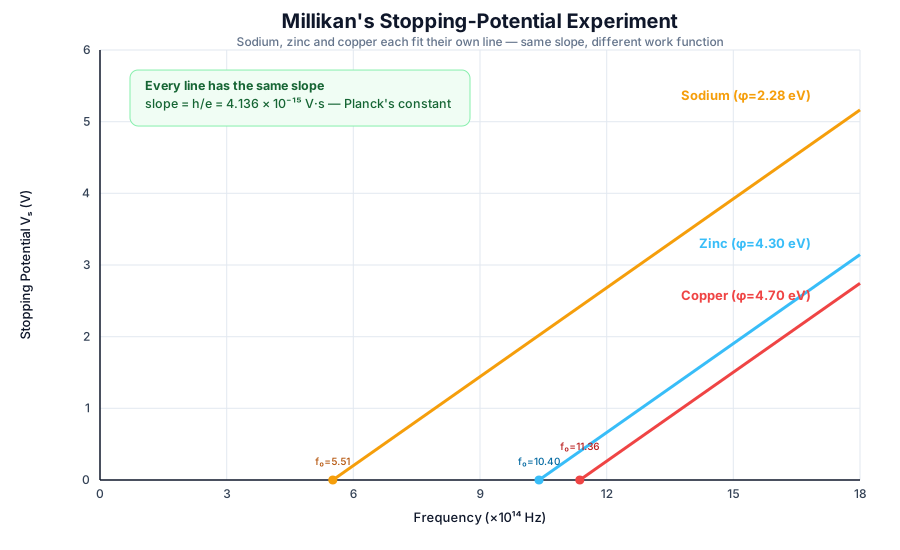
The slope is the same physical constant — — no matter which metal produced it, exactly what let Millikan treat separate metals as separate measurements of one universal number.
7. Applications Today
The photoelectric effect isn't just historical curiosity. It underpins most modern light-detection technology:
Solar cells — photons excite electrons across the semiconductor band gap, driving a photovoltaic current. This is the internal photoelectric effect: electrons are freed within the material rather than ejected into vacuum, but the underlying quantum mechanism — one photon, one electron excitation — is the same. Learn more in the Solar Cells article.
Digital cameras — CCD and CMOS image sensors use the photoelectric effect in each pixel. Every photo you take is a count of ejected electrons collected per exposure.
Photomultiplier tubes — a single photon ejects one electron, which cascades into millions through successive dynodes. Used in particle physics detectors and medical PET scanners.
UV photodetectors — solar-blind sensors built from wide-bandgap semiconductors (AlGaN) that only respond to deep-UV photons, used in flame and fire detectors precisely because sunlight can't trigger a false alarm.
Night-vision goggles — photons from faint infrared sources eject electrons from a photocathode, which are amplified and converted back to a visible image.
X-ray detectors — high-frequency X-ray photons (keV range) eject inner-shell electrons. The resulting signals reveal material composition in airport security scanners and medical CT machines.
Gamma-ray detectors — the same photomultiplier tubes mentioned above, tuned to catch the 511 keV photons a PET scanner's tracer produces, or the 140 keV photons a SPECT scan uses.
Which Technology Can Your Photon Trigger?
Drag the single slider below — it's continuous all the way from near-infrared to gamma rays — and watch which real devices from the list above a photon at that energy could actually activate.
Worked Examples
Worked Example
Example 1 — Finding max KE for UV light on zinc
A 250 nm ultraviolet photon strikes a zinc surface. Calculate the maximum kinetic energy of the ejected electron.
Given:
- λ = 250 nm
- Metal = Zinc with φ = 4.30 eV
- hc = 1240 eV·nm (convenient form)
Solution:
First, find the photon energy:
Apply Einstein's photoelectric equation:
The ejected electron carries a maximum kinetic energy of 0.66 eV.
Worked Example
Example 2 — Finding the stopping potential for sodium
A 300 nm ultraviolet photon is incident on sodium. What stopping potential is required to halt the fastest electrons?
Given:
- λ = 300 nm
- Metal = Sodium with φ = 2.28 eV
- hc = 1240 eV·nm
Solution:
Calculate the photon energy:
Find the maximum kinetic energy:
The stopping potential relates directly to kinetic energy (since the work done by the electric field equals the electron's KE):
A reverse voltage of 1.85 V is required to stop all ejected electrons.
Worked Example
Example 3 — Will visible red light eject electrons from copper?
Red light at 650 nm shines on a copper surface. Explain whether electrons will be emitted, and find the threshold wavelength for copper.
Given:
- λ = 650 nm (visible red)
- Metal = Copper with φ = 4.70 eV
- hc = 1240 eV·nm
Solution:
Calculate the photon energy for red light:
Compare with the work function:
Conclusion: No electrons will be emitted. The photon lacks sufficient energy to overcome the surface barrier, regardless of light intensity. A million red photons cannot eject a single electron — this is the key insight that disproved classical wave theory.
Now find the threshold wavelength:
Copper requires ultraviolet photons at or shorter than 264 nm to emit electrons. Since visible light (400–700 nm) is much longer, it cannot trigger the photoelectric effect in copper.
8. Quantum vs Classical: what changes?
The toggle in the simulation lets you switch between two models of light — and the difference is profound.
In the quantum model, each photon carries a fixed packet of energy determined by its frequency: . Below the threshold frequency, no photon has enough energy to eject an electron — no matter how many photons you fire. Doubling the intensity just doubles the number of ejected electrons, not their speed.
In the classical wave model, light was expected to behave like a continuous wave. Given enough intensity (enough energy delivered over time), any wavelength should eventually shake electrons loose. Try it: switch to Classical mode and crank up the intensity to 5 or above with red light (λ > 600 nm). Electrons emit — even though quantum mechanics says they shouldn't.
This is exactly what classical physics predicted, and exactly what Einstein's 1905 experiment disproved. The photoelectric effect showed that energy comes in discrete quanta, not continuous waves — a result so revolutionary it earned Einstein the Nobel Prize, not relativity.
Frequently Asked Questions
Quick Reference
| Quantity | Formula | Unit |
|---|---|---|
| Photon energy | eV | |
| Work function | (metal property) | eV |
| Threshold wavelength | nm | |
| KE of ejected electron | eV | |
| Stopping potential | V | |
| Planck's constant | eV·s |
Related Concepts
Explore more simulations
Every concept on PhysicStuff has an interactive simulation. No login, no setup required.